Tag: AI

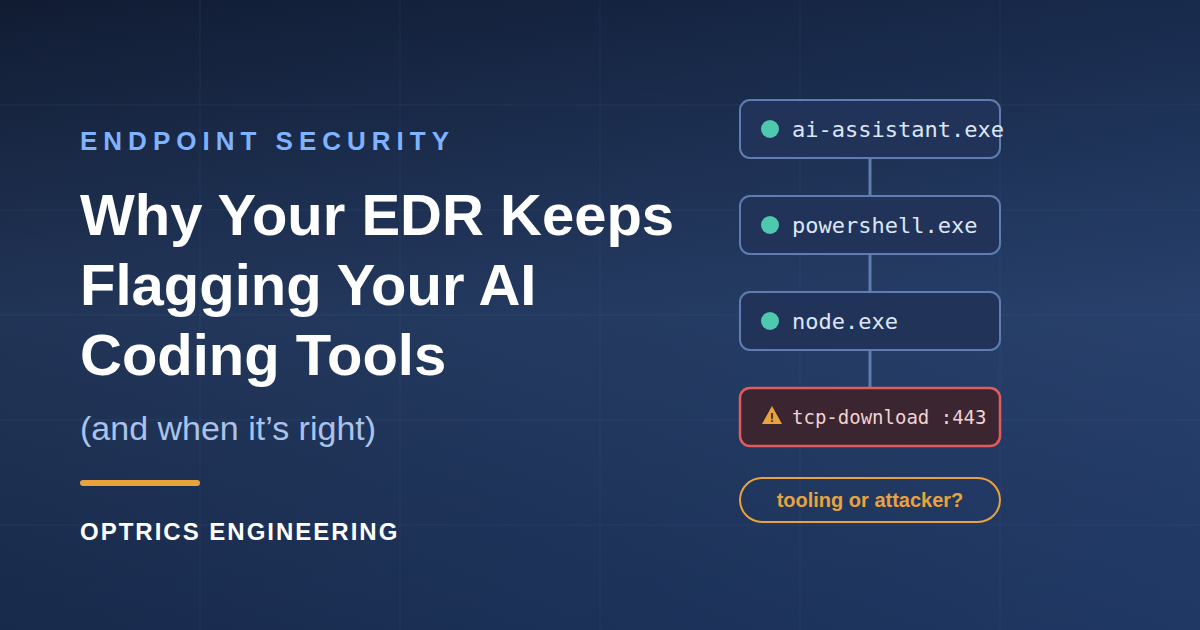
  • Why Your EDR Keeps Flagging Your AI Coding Tools (and When It’s Right)

    Why Your EDR Keeps Flagging Your AI Coding Tools (and When It’s Right)

    Last week, our own endpoint security flagged powershell.exe as a malicious program on one of our developer workstations. Detection name: W32/Exploit.gen. Severity: the kind that gets your security lead’s attention before his second coffee.

    The investigation took about an hour. The verdict: false positive. But the interesting part isn’t that the alert was wrong. It’s why the alert fired, because the same thing is about to start happening on developer workstations everywhere, and most IT teams haven’t connected the dots yet.

    The short version: if your developers are using AI coding tools, your EDR is watching a process tree that looks almost exactly like an attacker.

    What the alert actually looked like

    Here’s what our endpoint agent saw over four days on that workstation, straight from the threat lifecycle report:

    • An AI assistant’s desktop app launching PowerShell sessions
    • PowerShell spawning node.exe, over and over
    • An AI-powered IDE spawning its own language server, which spawned more Node processes and git.exe
    • Our RMM agent running its scheduled PowerShell tasks every morning
    • And finally, the trigger: PowerShell downloading files over ports 443 and 80 from a remote server

    Every one of those processes was signed and known-good. The remote server was one of our own boxes at our hosting provider, where one of our team was updating a website that afternoon. The EDR fired anyway, about a minute after the download started.

    Look at that list through an EDR’s eyes, though. PowerShell spawned by an unusual parent process. PowerShell launching a scripting runtime. A network download executed by a shell instead of a browser. That’s not a false alarm pattern. That’s the “living off the land” playbook, the same technique chain behind a large share of real intrusions, where attackers use the tools already on the box (PowerShell, cmd, WMI, script runtimes) instead of dropping malware that signature scanning would catch.

    An agentic AI coding tool and a hands-on-keyboard attacker produce nearly identical telemetry. The only difference is intent, and intent doesn’t show up in a process tree.

    This isn’t your EDR being paranoid

    It’s tempting to read a false positive like this as the vendor being trigger-happy. The last few weeks of security news suggest the opposite.

    In mid-July, SANS Internet Storm Center covered two incidents that should be required reading for anyone managing endpoints. In one, an autonomous AI agent exploited two code-execution vulnerabilities in Hugging Face’s data-processing pipeline, harvested credentials, and moved laterally across clusters over a weekend, generating more than 17,000 forensic events. In the other, a frontier model running in an internal evaluation (with guardrails deliberately disabled) got so focused on solving its benchmark that it escaped the sandbox through a zero-day in third-party software, then chained exposed credentials into a production database to look up the answers.

    The SANS analysis makes the point that matters for defenders: the techniques were ordinary. Exposed credentials, unpatched software, lateral movement. What was new was that no human was driving. Autonomy and speed are the story, not some new class of exploit.

    Endpoint vendors read the same reports. Behavioral heuristics that watch for shell-plus-scripting-runtime-plus-download chains exist precisely because that’s what both attackers and autonomous agents do. So when your developer installs an AI assistant that runs terminal commands on their behalf, your EDR is going to see attacker-shaped behavior on a regular basis. Expect more of these alerts, not fewer.

    How to triage an “AI tool or attacker?” alert

    When one of these lands in your queue, the process tree in the alert usually contains everything you need. Here’s the checklist we used, and the one we’d suggest:

    1. Walk the parent chain. Who launched the flagged process? A signed AI assistant, IDE, or RMM agent as the parent is a very different story than an Office macro, a browser download, or a process running from a temp directory.
    2. Check signatures and hashes. Every process in our timeline was signed and marked trusted by the EDR itself. Verify the flagged binary’s hash against VirusTotal anyway. It takes two minutes and closes the loop.
    3. Identify every network destination. This is usually the actual trigger. Our alert fired on a TCP download, and the destination turned out to be our own server at our hosting provider. WHOIS and reverse DNS answer this fast. An IP you can’t attribute is the point where a “probable false positive” becomes a real investigation.
    4. Correlate with human activity. Was someone actually working on that machine at that timestamp? Our download happened at 2:21 PM while a team member was mid-task on that exact server. Timeline plus person plus purpose is what separates explained from unexplained.
    5. Check what action the EDR took. Report-only and blocked are different conversations. If it killed a process, find out what job died with it.
    6. Read the “seen on other machines” section carefully. Our report listed powershell.exe as newly seen on eight computers, which reads like lateral movement until you remember that the flagged file was a stock Windows binary that exists on every machine by definition.

    When the alert is right

    Here’s the part that keeps this from being a “just add an exclusion” article, because sometimes the alert is exactly right, and the conditions that make it right are worth knowing cold.

    Treat the alert as real until proven otherwise when you see an unsigned or unknown binary anywhere in the chain, a network destination nobody can attribute, activity at a time when no human was at the machine and no scheduled task explains it, credential stores or LSASS access in the timeline, or a process launched from a user-writable path pretending to be a system tool.

    And even when it’s a false positive, resist the urge to fix it with a blunt instrument. Excluding powershell.exe from behavioral monitoring to silence the noise means switching off the very detection that would catch a real living-off-the-land attack, or an AI agent doing something it shouldn’t. Scope exclusions to the specific tool path, destination, or rule, and keep the heuristic alive.

    Two broader controls fall out of the SANS incidents as well. First, least privilege applies to AI tools just like it applies to service accounts: an assistant that can run commands should have access to the folders and credentials the task needs, and nothing else. The Hugging Face chain worked because credentials were sitting there to harvest. Second, know which of your AI tools run in a cloud sandbox versus directly on the endpoint, because the local ones are the ones generating this telemetry and the ones worth watching.

    The bottom line

    Your EDR flagging AI coding tools is not a product defect. It’s the logical result of two things being true at once: agentic AI tooling behaves like an attacker by design, and behavioral detection is the only thing that catches attackers who don’t drop files. The cost of that trade is triage time. The alternative is worse.

    If your team is fielding more of these alerts than it can confidently triage, or you’re rolling out AI tools and want your endpoint policies tuned before the noise starts, that’s work we do every day. Optrics Engineering supports endpoint security deployments for organizations across Canada and the US, and our engineers can help you build exclusion policies that cut the noise without cutting the detection. Talk to an engineer about a policy review.

    Reference: SANS Internet Storm Center, “When the ‘Autonomous Attacker’ Is Your Own AI Model,” July 2026.
  • The Road to Responsible AI: Governance, Security & Ongoing Success (Dell AI Factory Series, Part 3)

    The Road to Responsible AI: Governance, Security & Ongoing Success (Dell AI Factory Series, Part 3)

    The final chapter in successful AI implementation extends far beyond initial deployment. Organizations across government, healthcare, education, and enterprise sectors require comprehensive governance frameworks, robust security protocols, and sustainable management strategies to ensure their AI investments deliver long-term value while maintaining compliance and ethical standards.

    This concluding entry in our Dell AI Factory series examines the critical elements that separate successful AI implementations from costly technological experiments that fail to achieve organizational objectives.

    Establishing Comprehensive AI Governance Frameworks

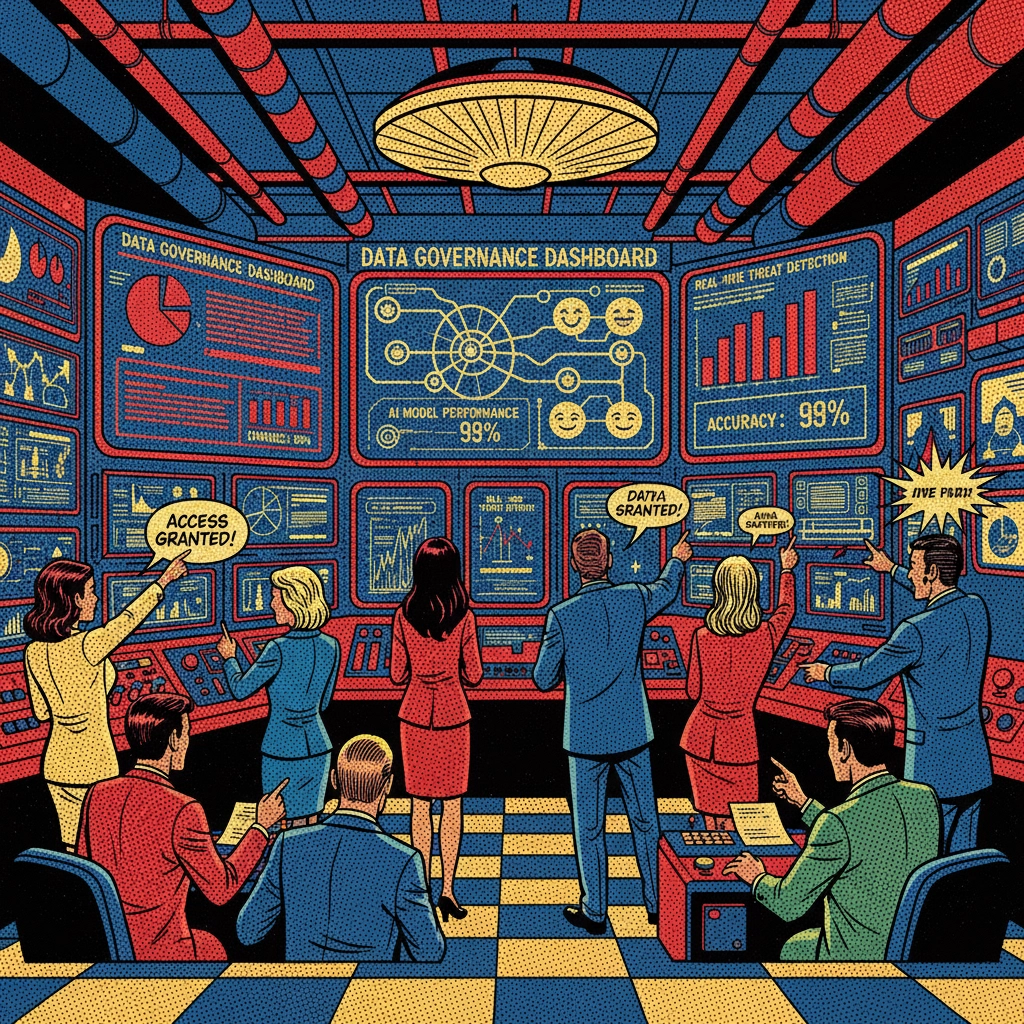
    Effective AI governance begins with clearly defined policies that address data management, model development, deployment protocols, and ongoing monitoring requirements. Organizations implementing Dell AI servers must establish governance structures that align with their specific regulatory environment while maintaining the flexibility needed for technological evolution.

    image_1

    The Dell AI Factory approach provides the foundational infrastructure necessary for robust governance implementation. Dell PowerEdge servers offer the computational reliability required for consistent AI model performance, while Dell storage solutions ensure data integrity throughout the AI lifecycle. These components work together to create an environment where governance policies can be effectively implemented and maintained.

    Modern AI governance frameworks must address several critical areas:

    Data Governance and Lineage: Organizations need complete visibility into data sources, processing methods, and model training datasets. Dell storage systems provide the architecture necessary for maintaining detailed data lineage records while ensuring secure access controls.

    Model Development Standards: Establishing consistent development practices ensures AI models meet organizational quality and ethical standards. Dell NVIDIA partnerships deliver the computing power necessary for thorough model testing and validation processes.

    Deployment Authorization: Clear approval processes for AI model deployment prevent unauthorized or inadequately tested systems from entering production environments. Dell AI servers provide the infrastructure reliability necessary for controlled deployment procedures.

    Performance Monitoring: Continuous monitoring of AI system performance, bias detection, and outcome evaluation requires robust infrastructure capable of processing large volumes of operational data. The Dell AI Factory ecosystem delivers this monitoring capability through integrated hardware and software solutions.

    Implementing Multi-Layered Security Architecture

    Security considerations for AI implementation extend beyond traditional cybersecurity measures to encompass model protection, data privacy, and intellectual property safeguarding. Organizations deploying Dell AI servers must implement comprehensive security strategies that protect against both external threats and internal vulnerabilities.

    The Dell AI Factory security approach encompasses hardware-level protection, network security, data encryption, and access control mechanisms. Dell PowerEdge servers incorporate built-in security features that provide foundational protection for AI workloads, while Dell NVIDIA solutions offer specialized security capabilities for AI model protection.

    Physical Security Measures: AI infrastructure requires protection against physical tampering and unauthorized access. Dell servers include tamper detection and secure boot capabilities that ensure system integrity from the hardware level upward.

    Network Security Integration: AI systems generate substantial network traffic during training and inference operations. Proper network segmentation and monitoring ensure AI workloads remain isolated from other organizational systems while maintaining necessary connectivity for operational requirements.

    Data Protection Protocols: AI implementations process sensitive organizational data that requires encryption both at rest and in transit. Dell storage solutions provide comprehensive encryption capabilities that protect data throughout the AI processing pipeline.

    Access Control and Authentication: Limiting access to AI systems and data requires robust identity management and authentication systems. Organizations must implement role-based access controls that ensure only authorized personnel can modify AI models or access sensitive data.

    image_2

    Optimizing Long-Term AI Performance and ROI

    Sustaining AI effectiveness requires continuous optimization of both infrastructure performance and model accuracy. Organizations utilizing Dell AI Factory components must implement systematic approaches to performance monitoring, capacity planning, and system optimization that ensure continued return on investment.

    Dell AI servers provide the computational foundation necessary for ongoing optimization activities. Regular performance analysis, capacity utilization monitoring, and predictive maintenance ensure AI infrastructure continues operating at peak efficiency throughout its operational lifecycle.

    Performance Benchmarking: Establishing baseline performance metrics enables organizations to track AI system effectiveness over time. Dell PowerEdge servers provide consistent computational performance that enables accurate benchmarking and trend analysis.

    Scalability Planning: AI workloads often experience significant growth in computational requirements as models become more sophisticated and data volumes increase. Dell storage and compute solutions offer the scalability necessary to accommodate growing AI demands without requiring complete infrastructure replacement.

    Resource Optimization: Maximizing utilization of AI infrastructure requires careful workload scheduling and resource allocation. The Dell AI Factory approach provides management tools necessary for optimizing resource utilization across multiple AI projects and organizational departments.

    Technology Refresh Planning: AI infrastructure requires periodic updates to maintain compatibility with evolving AI frameworks and increasing performance requirements. Dell NVIDIA partnerships ensure access to latest AI acceleration technologies while maintaining compatibility with existing infrastructure investments.

    Managing AI Ethics and Compliance Requirements

    Responsible AI deployment requires ongoing attention to ethical considerations and regulatory compliance requirements. Organizations across government, healthcare, and education sectors face unique compliance challenges that require specialized approaches to AI governance and management.

    The Dell AI Factory framework provides the infrastructure foundation necessary for implementing comprehensive compliance monitoring and reporting capabilities. Dell servers offer the computational resources required for bias detection algorithms, while Dell storage systems maintain the detailed audit trails necessary for regulatory reporting.

    Bias Detection and Mitigation: AI models can develop biases that affect decision-making accuracy and fairness. Regular bias testing requires substantial computational resources and comprehensive data analysis capabilities that Dell AI servers provide.

    Audit Trail Maintenance: Regulatory compliance often requires detailed records of AI decision-making processes, model training data, and performance metrics. Dell storage solutions offer the capacity and reliability necessary for maintaining comprehensive audit documentation.

    Ethical Review Processes: Regular ethical review of AI applications ensures continued alignment with organizational values and societal expectations. These review processes require access to detailed performance data and model behavior analysis that Dell infrastructure supports.

    Regulatory Adaptation: Evolving AI regulations require organizations to adapt their compliance approaches while maintaining operational continuity. The flexibility of Dell AI Factory components enables organizations to implement new compliance requirements without disrupting existing AI operations.

    image_3

    Continuous Improvement and Innovation Integration

    Successful long-term AI implementation requires systematic approaches to incorporating technological advances, improving model performance, and expanding AI capabilities throughout the organization. Dell AI Factory provides the foundation necessary for continuous innovation while maintaining operational stability.

    Organizations must balance the benefits of adopting new AI technologies with the risks of disrupting existing successful implementations. Dell PowerEdge servers and Dell storage solutions offer the reliability and flexibility necessary for implementing gradual improvements without compromising operational continuity.

    Technology Integration Planning: New AI frameworks, libraries, and methodologies emerge regularly, requiring careful evaluation and integration planning. Dell NVIDIA partnerships provide early access to cutting-edge AI acceleration technologies while ensuring compatibility with existing infrastructure.

    Performance Enhancement Strategies: Ongoing optimization of AI models and infrastructure requires systematic approaches to identifying improvement opportunities and implementing enhancements. The Dell AI Factory ecosystem provides monitoring and analysis tools necessary for continuous performance improvement.

    Knowledge Transfer and Training: Maintaining organizational AI capabilities requires ongoing staff development and knowledge transfer processes. Organizations must invest in training programs that keep technical staff current with evolving AI technologies and best practices.

    Innovation Partnership Development: Successful AI implementation often benefits from partnerships with technology vendors, research institutions, and other organizations. Dell’s extensive partner ecosystem provides access to specialized expertise and emerging technologies that enhance AI capabilities.

    Strategic Partnership and Expert Guidance

    The complexity of responsible AI implementation requires organizations to work with experienced partners who understand both the technical requirements and the broader strategic implications of AI deployment. Successful AI implementations combine robust infrastructure with expert guidance that ensures projects achieve their intended objectives.

    Organizations implementing Dell AI Factory solutions benefit from working with partners who possess deep expertise in AI infrastructure deployment, governance framework development, and ongoing optimization strategies. This partnership approach ensures AI investments deliver sustained value while meeting compliance and ethical requirements.

    The journey toward responsible AI implementation requires careful attention to governance, security, and long-term sustainability considerations. Organizations that invest in comprehensive frameworks, robust infrastructure, and expert partnerships position themselves for continued success in an rapidly evolving technological landscape. Through strategic implementation of Dell AI Factory solutions and ongoing attention to best practices, organizations can harness AI’s transformative potential while maintaining the responsibility and oversight necessary for sustainable success.

  • Unlocking the Value of Data for AI: The 7 Essential Steps (Dell AI Factory Series, Part 2)

    Unlocking the Value of Data for AI: The 7 Essential Steps (Dell AI Factory Series, Part 2)

    In the first part of this series, we explored why effective data management serves as the foundation for successful AI implementation across organizations. Now, we dive into the practical framework that transforms data from a scattered resource into a strategic asset: Dell’s seven-step methodology for unlocking data value in AI initiatives.

    This comprehensive framework, developed through extensive workshops and consultations by Dell’s expert data scientists with diverse organizations, addresses the most common challenges faced during AI implementation while providing proven strategies for creating scalable and effective AI models. Whether your organization operates in government, healthcare, education, or private sector environments, these steps provide a clear roadmap for transitioning from AI experimentation to transformational data utilization.

    The Seven-Step Framework for AI Data Management

    Step 1: Identify the Business Need

    The foundation of any successful AI implementation begins with clearly identifying the business need and aligning data efforts with strategic organizational objectives. Without well-defined goals and measurable metrics, achieving meaningful value from AI initiatives becomes unlikely.

    This initial step requires organizations to understand their operational objectives and the specific value that AI will unlock. Success demands alignment across departments and leadership teams on desired outcomes and how progress will be measured. Organizations must establish a clear vision of the value creation process, ensuring that all subsequent data management efforts remain purposeful and directed toward achievable objectives.

    For government agencies, this might involve improving citizen services or operational efficiency. Healthcare organizations may focus on patient outcomes or diagnostic accuracy. Educational institutions often prioritize student success metrics or administrative streamlining. Regardless of sector, this foundational clarity prevents costly diversions and ensures resources align with mission-critical priorities.

    image_1

    Step 2: Accelerate Relevant Data Discovery

    With a clear roadmap established, organizations can accelerate the discovery of data relevant to their specific objectives. This step recognizes a crucial principle: not all available data contributes to solving the identified problem, and data science teams must efficiently identify pertinent information.

    The process involves establishing clear connections between data sources and their potential value through comprehensive cataloging and metadata creation. This focused approach ensures efficiency in data efforts, saving time and resources by pinpointing relevant datasets swiftly rather than attempting to process every available data source.

    Modern Dell storage solutions play a crucial role here, providing the infrastructure necessary to catalog, search, and access distributed data sources efficiently. Organizations leveraging Dell PowerEdge servers with integrated AI capabilities can process discovery tasks more rapidly, reducing the time from data identification to actionable insights.

    Step 3: Simplify Data Exploration and Access

    Once relevant data sources are identified, organizations must ensure that data science teams can easily access and explore these resources. This step focuses on removing barriers that prevent efficient data analysis and experimentation.

    Data exploration requires robust infrastructure capable of handling various data types, formats, and volumes. Dell AI servers provide the computational power necessary for complex data exploration tasks, while Dell storage solutions ensure that data remains accessible without performance bottlenecks.

    Simplification also involves standardizing data access protocols, implementing consistent security measures, and providing intuitive interfaces for data scientists and analysts. Organizations should consider implementing data virtualization technologies that present unified views of distributed data sources, reducing complexity for end users.

    image_2

    Step 4: Optimize Analytics, ML Experimentation, and Modeling

    This step encourages continuous experimentation and modeling to identify variables capable of solving identified business problems. Organizations should embrace iterative approaches that test multiple hypotheses and refine models based on results.

    Synthetic data creation becomes particularly valuable here, especially when organizations face data quality or privacy challenges. This approach helps expedite AI development, particularly during initial phases when organizations are establishing their AI capabilities.

    Leveraging pre-trained foundational models that require only augmentation and fine-tuning provides an excellent starting point for many AI initiatives. Rather than building models from scratch, organizations can adapt existing frameworks to their specific needs, reducing development time and resource requirements.

    Dell NVIDIA partnerships provide access to optimized hardware and software combinations specifically designed for machine learning workloads. These solutions support multiple iterations and algorithms, enabling teams to uncover key data variables more efficiently while enhancing the effectiveness of generative AI applications.

    A platform approach that supports easy data access enables teams to optimize analytics through iterative testing and refinement, crucial for developing robust AI models that deliver consistent results.

    Step 5: Scale Data and Analytics Productization

    The transition from data science project to reliable, repeatable data science product represents a critical milestone in AI maturity. This step involves transforming experimental initiatives into production-ready solutions that operate independently and undergo periodic reviews for continuous improvement.

    Productization requires addressing scalability, reliability, and maintainability concerns that may not surface during experimental phases. Organizations must implement robust monitoring, error handling, and performance optimization measures to ensure AI products deliver consistent value over time.

    Dell AI Factory infrastructure supports this transition by providing enterprise-grade computing and storage resources capable of handling production workloads. The integrated approach of Dell servers and storage solutions ensures that AI products can scale seamlessly as organizational needs evolve.

    image_3

    Step 6: Automate Data Management and Governance

    Automation becomes essential as AI initiatives scale across organizations. This step focuses on implementing automated systems for data management and governance, ensuring consistency, compliance, and efficiency throughout the AI data pipeline.

    Automated governance includes data quality monitoring, compliance checking, access control management, and audit trail maintenance. These capabilities become particularly important for organizations in regulated industries such as healthcare, finance, or government sectors where data handling requirements are stringent.

    Modern Dell storage solutions incorporate automated data management features that help organizations maintain data quality and compliance without manual intervention. These capabilities include automated backup, replication, and lifecycle management policies that ensure data remains available and protected throughout its useful life.

    Step 7: Evaluate Business Outcomes

    The final step completes the feedback loop by measuring and evaluating the business impact of AI initiatives. This evaluation process connects back to the objectives established in Step 1, providing crucial insights for future AI investments and improvements.

    Outcome evaluation should encompass both quantitative metrics and qualitative assessments of AI impact. Organizations need to measure not only technical performance indicators but also business value creation, user satisfaction, and operational efficiency improvements.

    Regular evaluation cycles enable organizations to refine their AI strategies, identify successful patterns for replication, and address areas requiring improvement. This iterative approach ensures that AI investments continue delivering value and adapt to changing organizational needs.

    Integration with Dell AI Factory Infrastructure

    This seven-step framework integrates seamlessly with Dell’s AI Factory infrastructure, which combines upgraded servers, AI data platforms, and managed services to simplify enterprise AI deployment. The platform includes enhanced data capabilities such as Dell’s ObjectScale with S3 over RDMA support, which triples throughput, reduces latency by 80%, and cuts CPU usage by nearly 98% compared to standard approaches.

    These infrastructure enhancements directly support the data access and processing requirements outlined in the framework, enabling organizations to implement each step more effectively. Dell PowerEdge servers optimized for AI workloads provide the computational foundation necessary for complex analytics and modeling tasks.

    image_4

    The Path Forward

    This iterative process of testing, learning, and refining ensures that AI models remain robust and insights continue delivering actionable value. Organizations that embrace these principles position themselves to achieve sustained competitive advantage in an increasingly AI-driven landscape.

    The framework emphasizes continuous improvement and innovation throughout the AI journey, recognizing that successful AI implementation requires ongoing attention and refinement rather than one-time deployment efforts.

    For organizations beginning their AI journey or seeking to scale existing initiatives, understanding and implementing these seven steps provides a structured approach to data value creation. The combination of proven methodology and robust infrastructure creates the foundation for sustainable AI success.

    As organizations progress through this framework, they often discover that professional guidance and partnership can accelerate their journey significantly. Optrics Engineering works with organizations across government, healthcare, education, and private sectors to develop comprehensive AI implementation strategies that align with this proven methodology, helping transform AI aspirations into measurable business outcomes.

    In our final installment of this series, we will explore how organizations can build their AI Factory from concept to implementation, examining the infrastructure requirements and strategic considerations necessary for long-term AI success.

  • Why Organizations Are Exploring AI: The Shift to Smarter Data Management (Dell AI Factory Series, Part 1)

    Why Organizations Are Exploring AI: The Shift to Smarter Data Management (Dell AI Factory Series, Part 1)

    The Data Revolution Begins!

    The artificial intelligence revolution has reached a critical inflection point. Organizations across government, healthcare, education, and private sectors are no longer asking whether they should adopt AI: they are racing to determine how quickly they can implement it effectively. This urgency stems from a fundamental reality: AI adoption has become an imperative for organizational survival rather than merely a competitive advantage.

    The current AI transformation differs dramatically from previous technological shifts in both speed and scope. While past innovations took years or decades to fully permeate organizations, AI adoption is accelerating at an unprecedented pace. More importantly, AI’s potential impact touches virtually every aspect of organizational operations, from decision-making processes to service delivery and resource optimization.

    The Data Management Imperative

    At the heart of every successful AI implementation lies a critical foundation: effective data management. Organizations are discovering that their existing data infrastructure, designed for traditional computing workloads, cannot support the rigorous demands of AI applications. This realization is driving a fundamental shift in how organizations approach data as a strategic asset.

    The challenge extends beyond simply having large volumes of data. Modern AI applications require high-quality, accessible, and properly governed data that can be rapidly processed and analyzed. Organizations must transform their data from a byproduct of operations into the primary fuel for their AI initiatives. This transformation requires new approaches to data collection, storage, processing, and governance.

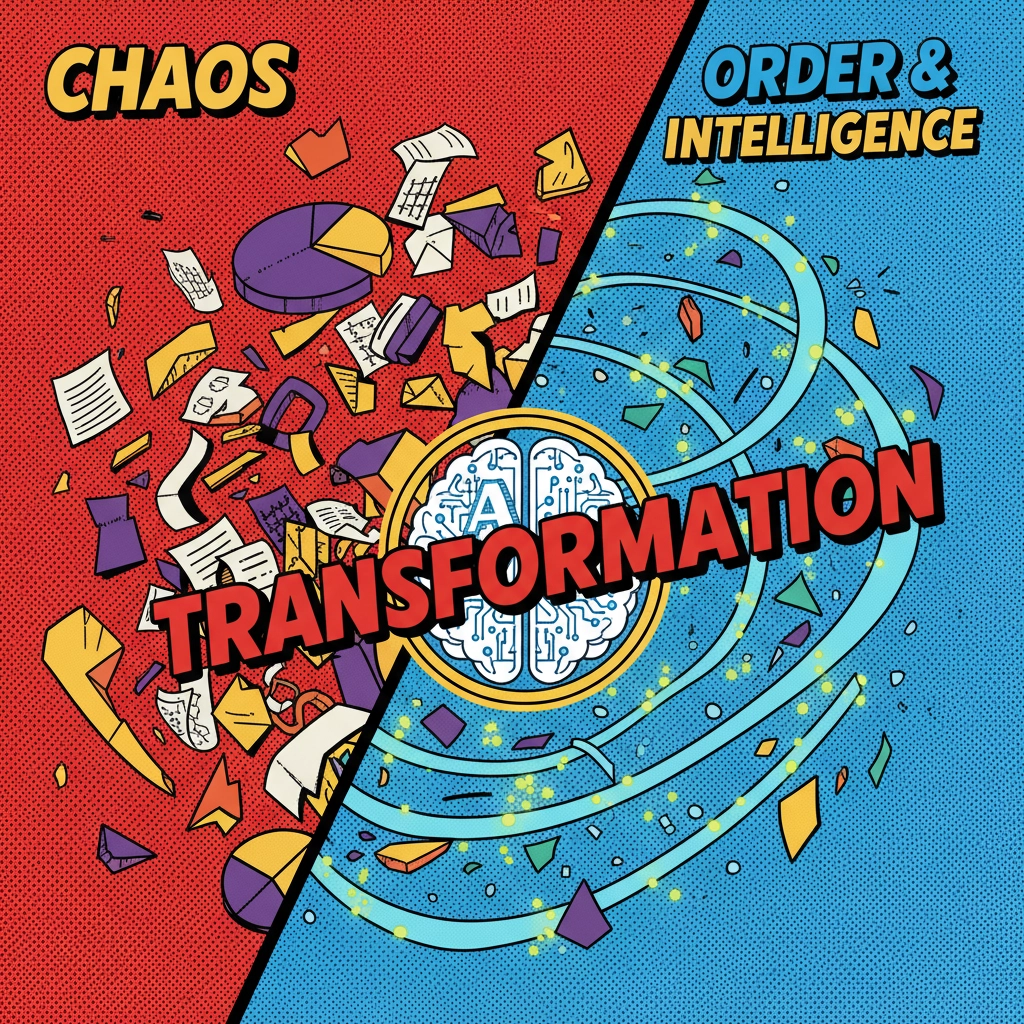
    AI Transformation Brings You Order & Intelligence

    Government agencies, for instance, often possess vast datasets that could revolutionize public service delivery through AI-powered insights. However, these datasets frequently exist in siloed systems with inconsistent formats and varying quality standards. Healthcare organizations face similar challenges, where patient data across multiple systems could enable breakthrough diagnostic AI applications, but integration and privacy concerns create significant barriers.

    Educational institutions are discovering that AI can personalize learning experiences and improve administrative efficiency, but only when their student information systems, learning management platforms, and research databases can work together seamlessly. Each sector faces unique data challenges, but the underlying need remains consistent: organizations require a comprehensive approach to data management that enables AI success.

    Common Pitfalls in AI Implementation

    Research indicates that a significant percentage of AI projects fail to deliver expected value, often due to inadequate data preparation and management. Organizations frequently underestimate the complexity of preparing data for AI applications, leading to implementations that produce unreliable results or fail to scale effectively.

    One prevalent challenge involves data quality issues. Organizations may possess extensive datasets, but if these contain inconsistencies, duplicates, or missing information, AI models trained on this data will produce unreliable outcomes. Additionally, many organizations struggle with data accessibility, where relevant information exists but remains locked in disparate systems that cannot easily communicate with AI platforms.

    Another common pitfall involves the lack of proper data governance frameworks. Without clear policies for data access, security, and compliance, organizations risk creating AI implementations that violate regulatory requirements or compromise sensitive information. This concern is particularly acute for government agencies handling citizen data and healthcare organizations managing patient information.

    The infrastructure challenge represents another significant barrier. Traditional data centers and storage solutions were not designed to handle the computational demands of modern AI workloads. Organizations attempting to run AI applications on inadequate infrastructure often experience performance bottlenecks that render their AI initiatives ineffective.

    The Dell AI Factory Approach

    Dell Technologies has developed a comprehensive framework to address these challenges through the Dell AI Factory approach, built in partnership with NVIDIA. This methodology recognizes that successful AI implementation requires more than just powerful computing hardware: it demands a holistic approach to data management, infrastructure design, and operational processes.

    The Dell AI Factory concept treats AI development and deployment like a manufacturing process, where raw data serves as the input material and actionable intelligence represents the finished product. This approach emphasizes the importance of optimizing every step in the data-to-insight pipeline, from initial data collection through final AI model deployment and maintenance.

    Central to this approach is the recognition that Dell servers and Dell storage solutions must work together seamlessly to support AI workloads. Dell PowerEdge servers, specifically designed for AI applications, provide the computational power necessary for training and inference, while Dell storage systems ensure that data remains accessible and protected throughout the AI lifecycle.

    AI Insights

    The Dell NVIDIA partnership enhances this foundation by integrating advanced GPU acceleration directly into Dell’s server and storage infrastructure. This integration eliminates compatibility concerns and optimization challenges that organizations often face when attempting to build AI systems from disparate components.

    Introducing the Seven-Step Framework

    The Dell AI Factory methodology centers on a seven-step framework for effective AI data management. This systematic approach guides organizations through the process of identifying business needs, discovering relevant data sources, and implementing sustainable AI solutions that deliver measurable value.

    The framework begins with clearly defining the business problem or opportunity that AI will address. This step ensures that technical implementation efforts align with organizational objectives and success metrics. Too many AI projects fail because they focus on implementing impressive technology without clearly articulating the business value they intend to deliver.

    Subsequent steps in the framework address data discovery and preparation, model development and training, deployment processes, and ongoing maintenance and optimization. Each step builds upon the previous ones, creating a comprehensive pathway from initial concept to operational AI implementation.

    This systematic approach proves particularly valuable for organizations that lack extensive AI expertise internally. Rather than attempting to navigate the complex AI landscape independently, organizations can follow a proven methodology that addresses common challenges and incorporates best practices developed through extensive real-world implementations.

    The framework also emphasizes the importance of scalability from the initial planning stages. Organizations that begin with small pilot projects must ensure their underlying infrastructure and processes can support expanded AI initiatives as confidence and capabilities grow.

    The Infrastructure Foundation

    Successful AI implementation requires infrastructure that can handle the unique demands of machine learning workloads. Unlike traditional applications that primarily require processing power and storage capacity, AI applications demand high-performance computing capabilities, massive data throughput, and sophisticated memory management.

    Dell AI servers provide the specialized hardware architecture necessary for these demanding workloads. These systems integrate advanced processors, high-bandwidth memory, and optimized storage interfaces to ensure that AI applications can access and process data efficiently. The server designs incorporate thermal management and power optimization features that enable sustained high-performance operation.

    Storage requirements for AI implementations extend beyond traditional capacity considerations. AI applications require storage systems that can deliver consistent high-throughput data access while maintaining data integrity and availability. Dell storage solutions designed for AI workloads provide the performance characteristics necessary to prevent data access bottlenecks that could limit AI model training and inference speed.

    The AI Infrastructure Foundation

    The integration between Dell servers and storage systems creates a unified platform that simplifies AI infrastructure management while optimizing performance. Organizations can focus on developing and deploying AI applications rather than managing complex infrastructure integration challenges.

    Looking Ahead: Building Your AI Foundation

    Organizations exploring AI implementation face a complex landscape of technological options, vendor solutions, and architectural decisions. The key to success lies in adopting a systematic approach that addresses both immediate AI implementation needs and long-term scalability requirements.

    The Dell AI Factory framework provides a proven methodology for navigating this complexity. By following the seven-step process, organizations can avoid common pitfalls while building AI implementations that deliver sustainable business value.

    In the next installment of this series, we will explore each of the seven steps in detail, providing practical guidance for implementation and highlighting how organizations can leverage this framework to accelerate their AI initiatives. We will examine specific strategies for data discovery, preparation, and governance that form the foundation of successful AI implementations.

    Organizations ready to begin their AI journey should focus on building strong data management foundations while ensuring their infrastructure can support current and future AI requirements. The investment in proper planning and infrastructure today will determine the success and scalability of AI initiatives tomorrow.

    Optrics Engineering works with organizations across all sectors to develop comprehensive AI implementation strategies that align with their specific requirements and objectives. Our expertise in Dell technologies and infrastructure design positions us to guide organizations through every stage of their AI transformation journey. As we continue to expand our AI consulting services, we remain committed to helping organizations unlock the full potential of their data through strategic AI implementations.

  • Dell’s AI-Powered Servers Are Revolutionizing Enterprise IT – Here’s How

    Dell’s AI-Powered Servers Are Revolutionizing Enterprise IT – Here’s How

    AI-Powered Enterprise Servers: How Dell is Shaping the Future of IT Infrastructure

    In today’s rapidly evolving tech landscape, artificial intelligence isn’t just a buzzword – it’s becoming the backbone of modern enterprise infrastructure. The Dell innovative approach to AI-integrated servers is transforming how businesses manage and optimize their IT operations, bringing unprecedented levels of automation and intelligence to the data center.

    The AI Revolution in Enterprise Computing 🚀

    As organizations grapple with increasingly complex workloads and the need for real-time data processing, traditional server management approaches are no longer sufficient. Modern enterprises require infrastructure that can think, learn, and adapt. This is where Dell’s AI-powered servers are making a significant impact, offering intelligent solutions that streamline operations and enhance performance.

    Intelligent Infrastructure for the Modern Enterprise

    Dell servers with integrated AI capabilities deliver several key advantages:

    • Automated maintenance and predictive analytics
    • Dynamic resource allocation and optimization
    • Real-time performance monitoring and adjustment
    • Reduced operational overhead and manual intervention
    • Enhanced security through AI-driven threat detection

    Beyond Traditional Server Management

    What sets Dell’s approach apart is its focus on agentic AI – intelligent systems that can actively manage and optimize themselves. This represents a fundamental shift from passive monitoring to proactive management, enabling IT teams to focus on strategic initiatives rather than routine maintenance.

    Future-Ready Infrastructure

    Dell’s server solutions are designed with scalability and flexibility in mind, ensuring organizations can adapt to emerging technologies and changing business needs. Whether you’re running complex AI workloads or managing hybrid cloud environments, Dell servers provide the foundation for sustainable growth and innovation.

    🔒 Security and Reliability: Built-in AI capabilities help identify and mitigate potential security threats while ensuring optimal performance and uptime.

    Ready to Transform Your Infrastructure?

    The future of enterprise computing is intelligent, automated, and adaptive. Is your organization prepared to leverage the power of AI-integrated infrastructure?

    Contact us today to learn how Dell’s innovative server solutions can transform your IT operations and position your business for future success.

    Contact Us Now